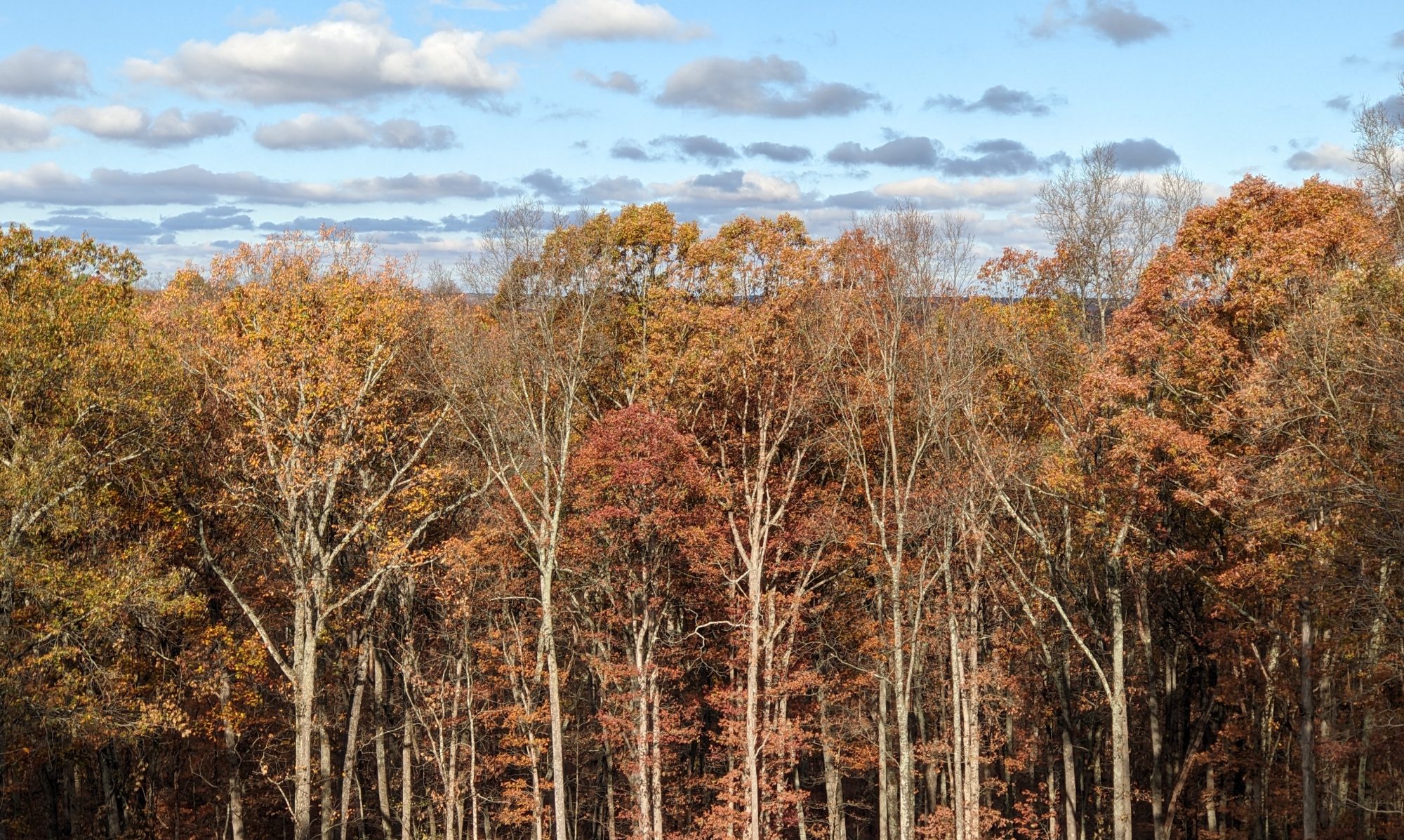
When I hike alone, I prefer to be by myself (with apologies to George Thorogood)

I had three chairs in my house; one for solitude, two for friendship, three for society.

– Henry David Thoreau

I have always been an introvert and have cultivated it carefully throughout my life lest I appear too anti-social.  It’s a delicate dance.  Don’t get me wrong, I will always enjoy the company of family and friends but there are times when I prefer to be alone.  This extends into the woods where I often prefer my only company to be the trees, birds, and squirrels.  When I am alone in the woods, I am much more introspective than anyplace else because I slow down and immerse myself in my surroundings.  There is no idle chat, no material distractions, my focus is in the moment, no past, no future, only the present.  I am in my mind and it is in me.  Being alone is also a gut check on whether I still like me, am I good company for me?  If I can’t get along with me, who else could I get along with?

I have some wonderful hiking partners and enjoy excursions with each of them, but I have always lived by the creed that they must be chosen as wisely as one would a canoe mate.  Having been in a canoe with someone whose paddle strokes were incompatible with my own totally wore me out.   I tried to compensate and keep the canoe going straight but instead it became less like a boat and more like a bee, zigzagging from flower to flower.  Coupling that with a personality that didn’t much mesh with my own and I just wanted to jump out and swim for shore.  There have been times when I have passed by people in the woods and thought if I was with them I would run away screaming for my life.  I have had similar experiences at cocktail parties and other social gatherings.

This past Wednesday morning, I had the opportunity to escape society for a bit and take a walk in the woods.  It was an exceptionally beautiful day as the spring wildflowers were beginning to bloom; bloodroot, spring beauties, cut-leaf toothwort, Dutchman’s breeches, and violets dotted the woodland floor.  The sun gave me that sense of well-being it provides on a warm day after a period of cold and wet weather.  A strong wind was stirring the treetops and its low roar serenaded me as I wandered through the woods. The streams were still flowing and the chickadees and titmice were busy flitting through the understory.  I sat down on an old log at the edge of a wooded ravine and enjoyed a mid-morning coffee and snack.  A cup of coffee with oneself, while savoring the beauty of the woods, is singularly fulfilling.  No Starbucks drive-through can create such nectar.  My mind soared as free and clear as the wind and the sky.

Much too soon I had to tear myself away from the solitude and head on down the trail back to society.  I had just spent three hours alone in the woods and was at peace with the world.  As I drove back home, I began plotting my next excursion and remained steadfast that these solitary escapes are a wonderful gift and will always remain a part of my earthly life.  For it is in solitude that I am able to explore the deep reaches of my being, blow away the dust of the world, and discover something new and exciting about me.  It is also an opportunity to nurture my introvert, who is as much a part of me as my blue eyes and gray hair.  Meaningful solitude for me is a constant, it dares me to be alone, to throw off the yoke of expectations, and explore myself at depths unattainable in a crowd.

Solitude is not something you must hope for in the future. Rather, it is a deepening of the present, and unless you look for it in the present you will never find it.

– Thomas Merton

The Gateless Gate

20180406_083213

“The Great Way has no gate,
A thousand roads enter it.
When one passes through this gateless gate,
He freely walks between heaven and earth.”

From The Gateless Gate* by Mumon (1228 AD)

In Brown County State Park, about quarter mile past Weed Patch Hill, there is a simple wood gate along the road that marks the start of a path that heads south into the woods. I have passed it many times, never stopping, somehow feeling the gate was there to prevent my entry. As the path behind it disappeared into the woods, I would often wonder where it led and what natural and spiritual revelations might be revealed along the way. Just a few days ago, I finally overcame my misguided apprehension, swung open the gate, and walked through.

As I walked into the woods, a hazy fog lay close to the ground, obscuring more distant views and a light mist fell that wet my hair and jacket. Small droplets of water, heaven’s dew, clung to the trees and I tasted of a few drops rolling down the branch of a beech tree. I became oblivious to how wet I was and instead watched intently as each of my footsteps sank into the wet leaves that carpeted the ground. I soon became lost in time, no longer thinking about my watch, where I came from, or where I had to be. As I became totally absorbed in the moment, life’s challenges suddenly seemed inconsequential as nature enfolded me in her arms and my spirit soared through the woods.

Soon, it felt like I was in a rainforest rather than the temperate climate of Indiana.  The moisture hung heavy in the air, the brown bark of the trees was painted green, brown, and white by lichens. Rotting logs lay on the woodland floor, going back to from where they came.  A variety of mosses dotted the woods, each with its own color and texture, and fallen leaves, brown with decay, carpeted the ground.

Continuing along a ridgeline, I soon began to hear the sound of flowing water as two woodland streams began their journey to the valley floor. The water, flowing over the exposed sandstone bedrock, created small waterfalls that added to nature’s melody, a beautiful sound that never fails to enchant me. As I reached the valley floor, I was so enthralled by the moment that I walked back up each stream a ways to explore their finer details.

Then, following the main stream, I soon realized I was in familiar territory having walked it many times and in all seasons. It is in spring though that I find it most enjoyable as the flowing water brings the woods to life. Finally, catching a glimpse of the back side of Strahl Lake, I was soon walking the familiar path around its shoreline. The unknown had  become the known.

Ending my descent into the valley at the abandoned shelter house at the lake; I broke bread with myself, a brunch of cheese, bread, and salami. Topping it off with a nice crisp apple, I settled back for a moment and reflected on my morning. I thought of how blessed I have been in my life to have nature as a source of renewal, of rebirth, a guide when I need new focus. My descent through these wooded hills and into the valley required me to swing open a gate and enter a place I had never explored. I experienced that magical moment when my body, mind, and soul were bound together by nature’s golden thread. In the end, I really didn’t need to physically push open the gate at the top of the hill for it really was a gateless gate, a barrier of my own making. I must free myself from building gates and let life take me where it wants.

*The Gateless Gate, more accurately translated as The Gateless Barrier, is a collection of 48 Chan koans compiled in the early 13th century by the Chinese Zen master Wumen Huikai (Mumon); 1183–1260).

The Road Taken

But great grand schemes will give you grief.
Take what you need, that’s all.
A light craft takes the wind
and skims the water lightly.

Last Verse From Writing What I’ve Seen by Yuan Mei (1716-1798)

Many of you have known me for years and some of you are more recent acquaintances.  Let me say that I appreciate and love you all, for as much as I like being alone, I also love the company of friends and family.  This is a wonderful mix of society given to me by my father and late mother.  Dad loves to be around people and knows no stranger, while my mother could be in a crowd but much rather preferred an intimate gathering with close friends and family, or simply being alone.  I am a mix of both, but in the end though, aren’t we really a product of both our parents, like it or not?

I gained a love of nature early in life.  Whether barefoot on a summer day, going into the country with my grandfather, catching frogs, fishing, Boy Scout campouts, summer road trips with my family heading into our country to points north, south, east and west, backpacking trips into the wilderness with dad, and through it all gaining a love of nature and embracing it in all its facets.   That love remains as much a part of my soul as my dearest friends.

Boyhood too soon became manhood and with it the challenges it posed as I tried to build career and family.  As I look back on this transition, I regret that I didn’t follow my passion for nature but allowed myself to be sucked into the American expectation of success and money (note to young people, it’s gut check time).  I have many things I am thankful for (four children and a WONDERFUL wife) but the thing that eluded me was more intellectual and spiritual, not the material.  I had all the latter, a good home, a six-figure salary; I bought shit when I needed it, albeit not a bigger home, a second home, a fancy car, or a Gucci wallet.  I plowed my way up the food chain, and watched those around me unable to meet the ever demanding expectations of corporate life fall away like chaff.  I began to see the hypocrisy of this existence and I always asked myself if there wasn’t something better.  For me, it all came crashing down not yet a year ago but I crawled out from the destruction and I have never been happier.

So here I am now, writing my heart out about nature, spending some fantastic time with my girls, Katie and Sarah, taking them to school and being with them at the end of the day along with cooking, cleaning, and grocery shopping; I love you Mom, you set the example.  My adult sons have a new level of respect as I have eschewed the mindless pursuit of money and status.  I would have never imagined that I would be in this place just one year ago, but here I am and know this; I would never go back.  This Old Boy is happy where he is.

While the man is demanding more from those around me, I may be taking a weekday hike in the woods.  While others fight through airports to their next rendezvous and  drink in some lonely airport bar, I may be cracking open a beer and sitting in my Adirondack chair in my backyard, staring up at the blue sky, and listening to Dylan or the Dead.  I am not envious of those hungry for the next dollar.  I can only imagine what their lives would be like if they took a step back and asked the question, am I happy where I am, if is this the end of the line, has it all been worth the getting?  It is worth asking this of ourselves for it is a question we all have to be ready to answer.

The American Beech

I frequently tramped eight or ten miles through the deepest snow to keep an appointment with a beech-tree, or a yellow birch, or an old acquaintance among the pines. – Henry David Thoreau

The first thing I learned about trees as a child was that they were supposed to be climbed.  If I saw a low hanging branch, up I would go.  Whether it was the sugar maple in our backyard on Elm Street, the sweet gum on Chestnut Street, or the old apple trees on my aunt and uncle’s farm south of Waymansville, I viewed all trees as things to be scaled.  With age, heights have lost their appeal and I now prefer to view trees from solid ground.   No longer do I consider them as something to be conquered, rather I see them for their individual and collective beauty.

Although I love a stand of pines, I am especially drawn to the hardwoods; beeches, oaks, maples hickories, cherries and more.  Spending time in the woods among our native hardwood trees has been one of the blessings of my life.  To walk among these trees through the four seasons has allowed me to truly appreciate the cycle of life in the woods.  It has provided me with a deeper appreciation that life is change, but also with the belief that there will always be a spring.

Of our native hardwoods, the American Beech is one of my favorites.  An oil painting of a stand of beeches hangs above my fireplace, painted in the 1940’s by the Hoosier artist Bryan Tarlton.  His brushstrokes bring to life the gray bark of the trees, the leaves still clinging to the branches, a small woodland pond, and the bold clouds of a fall sky.  The painting invites me to step into it and go for a ramble in its woods.   The first verse of the poem, Beechwoods at Knole, by Victoria Sackville West also comes to mind –

How do I love you, beech-trees, in the autumn,
Your stone-grey columns a cathedral knave
Processional above the earth’s brown glory!

The American Beech stands straight and tall, its smooth, gray bark gleaming in the sun, as its boles reach out boldly from the trunk to grasp the earth.  It invites me to reach out and touch it, to feel its skin.  Its pale yellow leaves hang on into winter, providing a stark contrast to the browns and grays that now color the woods.  When a brisk wind blows, the leaves dance on the branches and their rustling sound sings a haunting ode to winter.  Yet when I look at these trees standing boldly in the woods, I am reminded that last year’s leaves will soon fall away and spring will once again return.

God is the experience of looking at a tree and saying, “Ah!” – Joseph Campbell

Oh, Spring! Where Art Thou?

We rang in the vernal equinox in my neck of the woods with ice on Tuesday followed by maybe six inches of snow overnight (I didn’t have the heart to measure it).  Although it is melting fast, I felt cheated out of the first day of spring.  If it had only been on Monday when I worked in shirt sleeves in my garden cleaning up last year’s growth.  My rhubarb is ready to leaf out, the daffodils are blooming, the hostas are poking their heads above ground, and the mint is giving up its fragrance.  As sure as I know my perennials will continue to emerge and new growth will break out all around me, I was still a bit melancholy over this meteorological turn of events.

Today, I was reading David Young’s translation of the Tang Dynasty poet, Du Fu, and came across the following poem written around 760 AD…

Rain on a Spring Night

Congratulations, rain
you know when to fall

and you know quite well
you belong to spring

coming at night, quiet
walking in the wind

making sure things
get good and wet

the clouds hang dark
over country roads

there’s one light from a boat
coming downriver

in the red morning
everything’s wet

flowers all through Chengdu
heavy and full of rain. 

Ah, we have hoped for spring for thousands of years and, as always, it comes back with its rain and flowers!

A Woodland Stream

Time is but the stream I go a-fishing in. I drink at it; but while I drink I see the sandy bottom and detect how shallow it is. Its thin current slides away, but eternity remains. – Henry David Thoreau

A walk in the woods for me is a journey of discovery, both of self and the natural world.  Often, I pause to take in the moment, explore its meaning and listen to its song.  Perhaps it is the wind blowing through a stand of pines, the soft babble of a small woodland stream, the rain falling on the leaves lying on the woodland floor, the birds flitting through the branches of the trees, the hoot of a barred owl, who-cooks-for-you, who-cooks-for-you-aaaaalllll, or the howl of a distant coyote.  Each experience in the woods builds upon the last and strengthens the inseparable bond I have with nature.

You can follow a woodland stream uphill in Brown County State Park until you reach the point it emerges from the underlying rock.  It is there that the soft trickle of water begins its long journey to the sea.  But it isn’t the thought of those distant shores that occupies me; it is just this small stream descending through these woods, its soft currents gliding gently over the 250 million year-old Mississippian age sandstones.  This small stream has more allure to me than a river cascading through the granite of some distant mountain range.  It is what lies immediately under my feet, over my head, and in my mind that holds the most allure.  This is my home ground, the place where my boot soles have collected the most dirt, where my experiences always create a flood of memories, where my flesh and bones belong.

In late fall and early winter the character of this small woodland stream lies hidden from view, bone dry and buried under a blanket of leaves.  It isn’t until the ground freezes and snowmelt and rain begin to push the leaves downstream that its hidden beauty will be revealed.  The work of ages soon becomes apparent; stones of different shapes and sizes fill the streambed with a variety of colors, each created over millions of years by the interaction of the sandstone with water and minerals.  The reds, browns, and tans of these stones creates an endless canvas of color; each square foot, each yard as unique as a fingerprint, a ribbon of color wandering through the woods.  The crystal clear water flowing over the bedrock shelves creates small cascades adding to the beauty of the woods.

It is humbling to pick up a stone from the stream and hold it in my hand and gaze upon 250 million years of the earth’s past.  At the same time, I gaze upon the buds on the trees, the wildflowers waiting to bloom, all the new growth that spring will soon bring to the woods, a reminder of new life, of new possibilities.  I also think of the stone and each single grain of sand within it and the ripples that fade away after I drop it in the stream.  These things remind me that in the end I am like a grain of sand, a small ripple in time disappearing into eternity.  Before I fade away, will I look back and know that I dove deeply into my life’s stream, went down to its depths, and explored its deepest currents?  Or, when I finally wash up on some distant shore will I have left these things unexplored, will I have left the stones in my stream unturned?

Dance of the Red-Tailed Hawk

Anyone who has ever stopped to watch a hawk in flight will know that this is one of the natural world’s most elegant phenomena. – John Burnside

________________________________________________________

The Red-Tail Dance

A shrill keeeer–keeeer pierces the spring sky.

Two large birds circle high above.

Suddenly, one rises vertically above the other.

Closing its wings, it then topples downward, accelerating towards the ground.

Its wings then open and it rises again to repeat this aerial display.

Soon grabbing hold of one another, claw to claw, they fall spiraling towards the earth in a poetic embrace.

Releasing each other, these mates glide together with their feet extended, forever…

jdeLap


The mating ritual of the red-tailed hawk (Buteo jamaicensis), which occurs each spring, is poetry in flight.  I can pause for long moments and watch this beautiful display until these wonderful birds soar from view.  For a moment, I am carried away with them in this dance of new life, thankful for spring and the gift of rebirth that has been given to us for millennia.

In a chapter of my life now past, I worked near the local airport and enjoyed watching a red-tailed hawk as it hunted in the vacant fields outside my office window.  So much so that I never want to see this slice of urban wild developed.  The hawk often perched on a light stanchion, which gave it a good view of the open fields and the voles that inhabited the grassy stubble.  Suddenly taking  flight, it would pounce on its prey.  I know that all did not end well for the vole, but it was simply the reality of nature and its cycle of birth and death.

When on the ground, I am always in awe of the size of this hawk and they are equally as impressive in flight.  They can reach up to 22 inches long and have a wingspan of up to 56 inches.  Their wingspan is just a foot shorter than I am tall.  Standing side by side, I could touch the top of this hawk’s head, which with bill can reach close to 3 ½ inches long.  Their sharp bill, used for tearing apart their prey, can be over an inch long in the adult and have a frightening downward turn at the end.  Their sharp talons, the hooked claws on all birds of prey, help insure that their meal won’t escape.  If I am prey, none of these things give me comfort.

The red-tail is our most common buteo, a genus of large, wide-winged, short-tailed soaring hawks.  Its territory includes the entire continental U.S., Canada, Alaska, and Mexico, with Indiana being well within its year-around range. Color variations exist across its territory but the most common diagnostic marking is the rufous or red tail of the adults.  Their prey includes voles, mice, birds, snakes, and insects, but they will take larger mammals such as rabbits and squirrels.  Although some 40 years ago, I still remember seeing a red-tail take a pigeon on the roof of a downtown building.  The hapless bird was quickly dispatched and then then carried to a nearby tree.  This moment, clearly etched in my mind, was the first time I had ever witnessed a hawk kill that close and I recall the primordial feeling that came over me.

No matter, when or where I see these birds, I am always in awe of this powerful raptor.  Maybe they are being harassed by smaller birds, feathered fighter pilots attempting to chase the enemy from the field.  I am never quite sure who I want to win the battle but the hawk usually retreats rather than put up a fight.  Or, I may see this beautiful bird sitting on a post, closely observing an open field, keeping an eye out for its next meal. But, I always listen for that wheezy keeeeer in the spring as these hawks soar above the earth, hopeful that I will once again witness poetry in the sky.

The spotted hawk swoops by and accuses me, he complains of my gab and my loitering.
I too am not a bit tamed, I too am untranslatable,
I sound my barbaric yawp over the roofs of the world.

The last scud of day holds back for me,
It flings my likeness after the rest and true as any on the shadow’d wilds,
It coaxes me to the vapor and the dusk.

 Walt Whitman, Song of Myself, verse 52

Image result for red-tailed hawk

    Photo Courtesy of the South Carolina Department of Natural Resources


The Old Well

“I went to the woods because I wished to live deliberately, to front only the essential facts of life, and see if I could not learn what it had to teach, and not, when I came to die, discover that I had not lived. I did not wish to live what was not life, living is so dear; nor did I wish to practise resignation, unless it was quite necessary. I wanted to live deep and suck out all the marrow of life, to live so sturdily and Spartan-like as to put to rout all that was not life, to cut a broad swath and shave close, to drive life into a corner, and reduce it to its lowest terms…” – Henry David Thoreau

The land that is now Brown County State Park was once the realm of the Delaware Indians who hunted in the virgin woods that once dominated the area.  The landscape looked quite different then as the settlers and logging interests had not yet arrived.  Beginning around 1840 and into the early 20th century most of the park’s forests were cleared for farming and logging, the larger trees at first for lumber and then the smaller ones for other uses.  A walk through Ogle Hollow Nature Preserve in the park provides some sense of what the land might have looked like before settlement and logging.  Large trees such as the rare yellowwood, sycamores, beeches, and a variety of oaks dominate the canopy.   The understory contains flowering dogwoods and redbud mixed with pawpaws, spicebush, ironwood, and musclewood.  Ferns and wildflowers are scattered across the forest floor.

Many years ago, I came across an old well in the park.  Not clearly visible unless you stumbled upon it, I found it after a blanket of snow had covered the ground.  Lined with blocks of Mississippian sandstone, each more than 250 million years old, the walls were still intact and in good shape in spite of their age.  There was still water visible in the bottom, although I would not attest to its potability.  Just as the pyramids of Egypt were built by human hands one stone at a time, this simple well was also.  The builder of the well may well have thought that it had far more value than those distant monuments to the pharaohs.

I can imagine a husband and wife, scratching out a homestead there by sweat and toil.  The well is located near a small intermittent stream that would have provided a good source of water in the winter and spring months.  The area around the well would have made a nice site for a homestead with ample hillside and flat ground for a few animals and crops.  Other than the old well, no evidence remains of their presence.  But I can still stand on a hill above the site and imagine a small farm bustling with activity, smoke curling from the chimney, and a meal being prepared in an outdoor kitchen.

Make no mistake, this was a rugged life.  They would have faced challenges we can only imagine today.  Wolves, black bears, and panthers roamed the area.  Hunger and diseases such as tuberculosis and pneumonia were constant shadows over this hardscrabble life.  Although Nashville was only a few miles away, travel through the dense forests that remained and the rough terrain would have made the trip an arduous undertaking.  Whatever crops could have been grown were likely supplemented by a hog and a few chickens as well as a variety of wild game.  History tells us that these farms eventually failed due to the poor quality of the soil, erosion, and deforestation.

By the early 1900’s, our homesteaders had probably pulled up stakes and moved on leaving behind a barren landscape.  As the area was abandoned, the state began acquiring the land which eventually became Brown County State Park and with the help of the Civilian Conservation Corp in the 1930’s, the forest again reclaimed the land.

So what led this husband and wife into the woods to scratch out a living?  Was it opportunity, the promise of a better life?  Or, was it a desire for the solitude of the woods, to escape from something in more civilized society?  In turn, what drove them away?  Was it a future that never materialized or the unforgiving land?  Was it disease and hardship or the continued influx of people?  We will never know the answer to these questions for they have been lost to history.

When I think of these settlers and the old well, I am compelled to consider my own reasons for going to the woods.  Why do I value so deeply the chance to spend time with nature?   The answer is as varied and complex as each of the seasons; whether winter’s icy blast, the new birth of spring, summer’s sun, or the pensiveness of fall, each of my experiences builds upon the last, forming a deep repository of memories, insights, learning, and discovery.  This is where I can escape for a while from the daily grind and explore deeply my connection with the natural world.  I can thumb my nose at society and become who really I am, free from the expectation that I conform to its mores.   My inner child is set free and explores the wonders that surround me, every moment holding the potential to discover something new and exciting.  I am as giddy as a schoolboy before recess.  This is something I simply cannot find or experience during the grind of each day where I often feel out of touch with the world.  I grow homesick and feel compelled to strap on my boots and return to the woods.  The old well is the perfect metaphor for my relationship with the natural world; no matter how often I dip my ladle into its depths, I always come away refreshed

“…The woods are lovely, dark and deep,
But I have promises to keep,
And miles to go before I sleep,
And miles to go before I sleep.”

Robert Frost, from Stopping by the Woods on a Snowy Evening


Writing What I’ve Seen

The following poem, Writing What I’ve Seen,  was written by Yuan Mei (1716-1798) who was considered not only one of the most popular poets of the Ch’ing Dynasty in 18th century China but also in the 2,500 year history of classical Chinese poetry.  I enjoy reading classical Chinese poetry, in part, for the unique perspective it gives me about nature and life.  This particular poem comes from the book, I Don’t Bow to Buddhas, Selected Poems of Yuan Mei, (translated from the Chinese by J.P. Seaton, Copper Canyon Press, 1997).

I feel a connection between this poem and Henry David Thoreau’s admonishment in Walden that we simplify our lives –

 “Our life is frittered away by detail.  Simplify, simplify, simplify!  I say, let your affairs be as two or three, and not a hundred or a thousand; instead of a million count half a dozen, and keep your accounts on your thumb-nail.”

And now, Yuan Mei…

Writing What I’ve Seen

All things that live
must make a living
There’s nothing got
without some getting.

From fabled beast to feeble bug
each schemes to make its way
The Buddha, or the Taoist Sage?
Unending in his labor;

and mornings herald, the rooster, too
can he not cock-a-doodle-do?
I hunger, so I plot to eat:
I’m cold, and would be robed…

But great grand schemes will give you grief.
Take what you need, that’s all.
A light craft takes the wind
and skims the water lightly.

May your life be simple and your craft, wherever it takes you, always skim the water lightly!


My Muse

There is no architect
Can build as the Muse can;
She is skillful to select
Materials for her plan.

– Ralph Waldo Emerson

Do you have a muse, someone or something that inspires you artistically?  Maybe your muse compels you to write poetry, play a musical instrument, dance, or paint.  When I first thought of myself as a writer, I hadn’t really given much thought about a muse.  Early on, there was a creative disconnect that existed between me and my subject.  It felt as if I were only dipping my toe into the deep well of my being.  Somehow, my thoughts became words but there wasn’t a feeling of giving myself up to my subject.  I knew I needed to find my muse and fully embrace its influence on my mind and spirit.

For certain, it was never going to reveal itself between 8 and 5, Monday through Friday, unless I had the day off.  Work, in large part, has been a means to an end for me.  There have been moments of satisfaction but they have come and gone quickly.  Throughout my life, the 8 to 5 grind has done more to separate me from my creative self than it has to embrace it.  Often times, I felt resigned to turn my back on my creative side and stumble blindly along in the relentless pursuit of money and status.  But it was these words of Henry David Thoreau in Walden that have always served as my wake-up call –

“The mass of men lead lives of quiet desperation.  What is called resignation is confirmed desperation. From the desperate city you go into the desperate country, and have to console yourself with the bravery of minks and muskrats.  A stereotyped but unconscious despair is concealed even under what are called the games and amusements of mankind.  There is no play in them, for this comes after work.  But it is the characteristic of wisdom not to do desperate things.”

Much too often, these words scared me out of my wits when I pondered whether resignation and desperation would overwhelm me.  They compelled me to always search for a way by which I could be delivered from this blind toil in pursuit of material gain.  By grace and luck, I have chosen not to do desperate things and have taken a different path.  The road has not been easy, but I am determined to stay the course and not allow resignation, desperation, and the relentless pursuit of money and status to be my epitaph.

So, all this time my muse has never been far away.   There is the spiritual haven I find in my garden.  Being able to till the soil in the spring; smell the fresh earth; hold it in my hands; to carefully place the seeds and plants in the soil; to nurture them to maturity; and then enjoy the fruits of my honest labor; to watch the butterflies and bumblebees that visit my flowers; to see the variety of birds at my feeders.   My garden is a sanctuary, a place I can go to escape from the deviltries of the day.

Just a few days ago, I hiked the Fire Tower Trail in Brown County State Park, a short but rugged 2.2 mile loop that takes you through a beautiful hardwood landscape.  It had rained during the night, so the trail was a bit sloppy and crossing a swollen creek required careful passage to avoid a soaking.  These were but minor obstacles in the way of enjoying the peace of being in the woods.  I stopped often to listen to the wind and watch the treetops sway back and forth in their ancient rhythm.  I heard the soothing sound of the stream running full, and watched its swirling currents pass quickly by.  I heard the pale leaves of the beech trees rattle in the winter wind.   Each pause filled my senses with joy, a pleasant reminder of why I have always sought out such places.

These moments, past, present and yet to come, allow me to turn inward and immerse myself in the deep well of my being.  The common bond that ties them all together is nature, my muse, and a fundamental part of my life since childhood.  It is a mind clearing experience for me to be with her.  The dust of the world disappears and she is at once nurturing, sensual and beguiling.  She invites me to explore her many moods and to embrace each as a friend and guide.  When I am with her, I am like a child again gazing in wonder at the natural world around me, giddy at the chance of discovering something that touches my very being.  I am that boy who bounded out the door of his house barefoot on a summer morning, in awe of the world around him, and who has yet to come back inside.

So, when I am in a creative lull and can’t find the right words to express my myself, I am always confident that a trip to the woods or garden to walk with my muse will provide what I seek.  I am liberated by nature and she helps me remove the shackles of my daily life; she unfetters me from time and the myopic perspective that I too often force upon myself.   With her, I dare to dream what I can be, rather than become what I don’t want to be.   With her, I stand in the woods and reach my hands to the sky and shout out, I am alive!

“Go to the country – The muse is in the woods” – Jean-Baptiste-Camille Corot