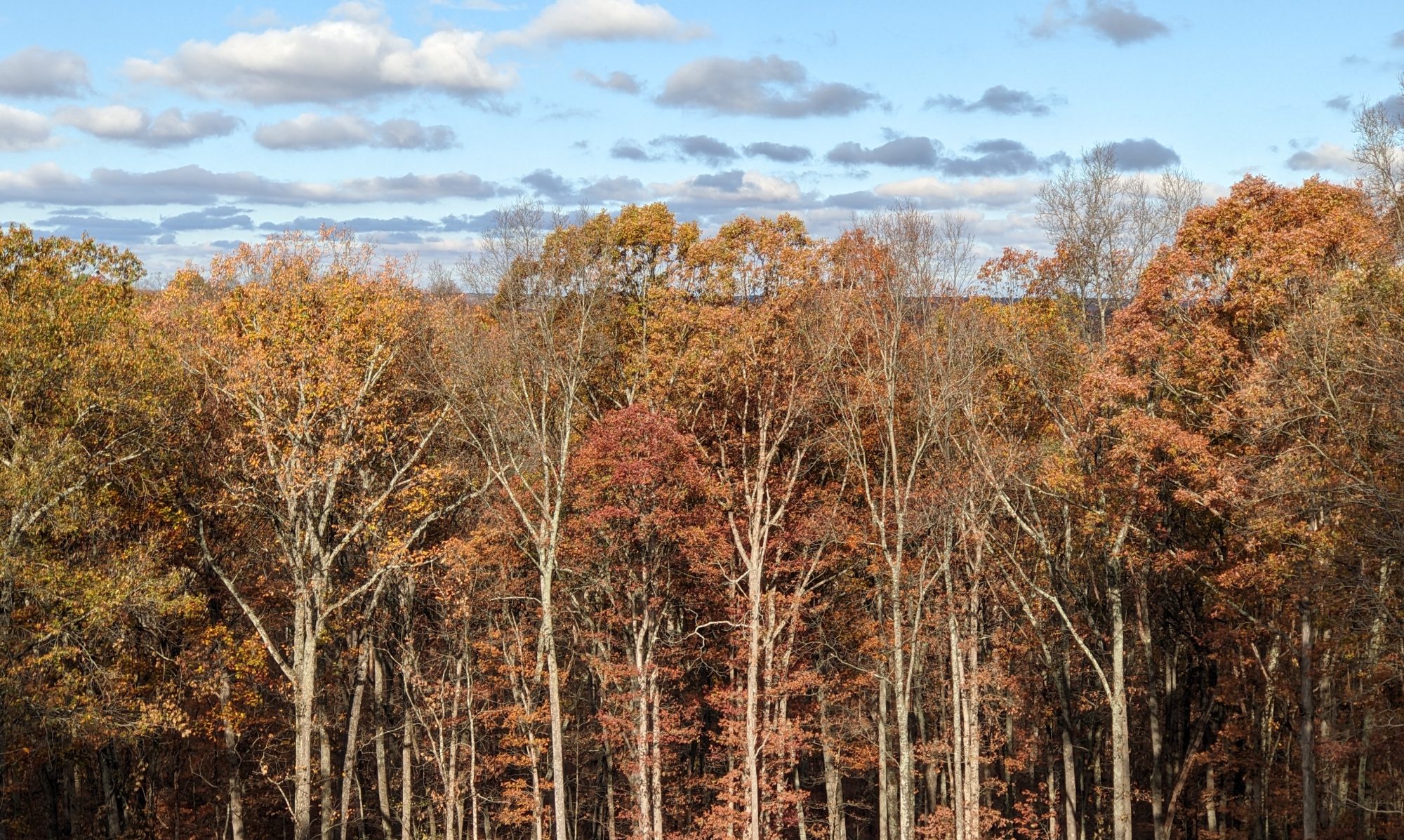
“I went to the woods because I wished to live deliberately, to front only the essential facts of life, and see if I could not learn what it had to teach, and not, when I came to die, discover that I had not lived. I did not wish to live what was not life, living is so dear; nor did I wish to practise resignation, unless it was quite necessary. I wanted to live deep and suck out all the marrow of life, to live so sturdily and Spartan-like as to put to rout all that was not life, to cut a broad swath and shave close, to drive life into a corner, and reduce it to its lowest terms…” – Henry David Thoreau
The land that is now Brown County State Park was once the realm of the Delaware Indians who hunted in the virgin woods that once dominated the area. The landscape looked quite different then as the settlers and logging interests had not yet arrived. Beginning around 1840 and into the early 20th century most of the park’s forests were cleared for farming and logging, the larger trees at first for lumber and then the smaller ones for other uses. A walk through Ogle Hollow Nature Preserve in the park provides some sense of what the land might have looked like before settlement and logging. Large trees such as the rare yellowwood, sycamores, beeches, and a variety of oaks dominate the canopy. The understory contains flowering dogwoods and redbud mixed with pawpaws, spicebush, ironwood, and musclewood. Ferns and wildflowers are scattered across the forest floor.
Many years ago, I came across an old well in the park. Not clearly visible unless you stumbled upon it, I found it after a blanket of snow had covered the ground. Lined with blocks of Mississippian sandstone, each more than 250 million years old, the walls were still intact and in good shape in spite of their age. There was still water visible in the bottom, although I would not attest to its potability. Just as the pyramids of Egypt were built by human hands one stone at a time, this simple well was also. The builder of the well may well have thought that it had far more value than those distant monuments to the pharaohs.
I can imagine a husband and wife, scratching out a homestead there by sweat and toil. The well is located near a small intermittent stream that would have provided a good source of water in the winter and spring months. The area around the well would have made a nice site for a homestead with ample hillside and flat ground for a few animals and crops. Other than the old well, no evidence remains of their presence. But I can still stand on a hill above the site and imagine a small farm bustling with activity, smoke curling from the chimney, and a meal being prepared in an outdoor kitchen.
Make no mistake, this was a rugged life. They would have faced challenges we can only imagine today. Wolves, black bears, and panthers roamed the area. Hunger and diseases such as tuberculosis and pneumonia were constant shadows over this hardscrabble life. Although Nashville was only a few miles away, travel through the dense forests that remained and the rough terrain would have made the trip an arduous undertaking. Whatever crops could have been grown were likely supplemented by a hog and a few chickens as well as a variety of wild game. History tells us that these farms eventually failed due to the poor quality of the soil, erosion, and deforestation.
By the early 1900’s, our homesteaders had probably pulled up stakes and moved on leaving behind a barren landscape. As the area was abandoned, the state began acquiring the land which eventually became Brown County State Park and with the help of the Civilian Conservation Corp in the 1930’s, the forest again reclaimed the land.
So what led this husband and wife into the woods to scratch out a living? Was it opportunity, the promise of a better life? Or, was it a desire for the solitude of the woods, to escape from something in more civilized society? In turn, what drove them away? Was it a future that never materialized or the unforgiving land? Was it disease and hardship or the continued influx of people? We will never know the answer to these questions for they have been lost to history.
When I think of these settlers and the old well, I am compelled to consider my own reasons for going to the woods. Why do I value so deeply the chance to spend time with nature? The answer is as varied and complex as each of the seasons; whether winter’s icy blast, the new birth of spring, summer’s sun, or the pensiveness of fall, each of my experiences builds upon the last, forming a deep repository of memories, insights, learning, and discovery. This is where I can escape for a while from the daily grind and explore deeply my connection with the natural world. I can thumb my nose at society and become who really I am, free from the expectation that I conform to its mores. My inner child is set free and explores the wonders that surround me, every moment holding the potential to discover something new and exciting. I am as giddy as a schoolboy before recess. This is something I simply cannot find or experience during the grind of each day where I often feel out of touch with the world. I grow homesick and feel compelled to strap on my boots and return to the woods. The old well is the perfect metaphor for my relationship with the natural world; no matter how often I dip my ladle into its depths, I always come away refreshed
“…The woods are lovely, dark and deep,
But I have promises to keep,
And miles to go before I sleep,
And miles to go before I sleep.”
Robert Frost, from Stopping by the Woods on a Snowy Evening


