Fooled Again

Every time I think I might have her figured out, nature reminds me that such belief is folly.  She consistently humbles, and every once in a while, makes me look like a dawgone fool.  But I would rather live in her world than in some man-made, gadget-centric one.  I would truly be the fool if I stayed in the house all day tethered to some electronic gadget or thought that sixty hours a week in some office would be a good use of my time.

I don’t go to an office anymore, at least not the bricks and mortar type.  The woods, the sky above and the dirt under my feet are my office, no desk and no passive-aggressive boss digging subtly at my performance.  I lived that life but came to the realization a long time ago that the fate of the free world didn’t depend upon me, or really anyone else for that matter.  That has been one of the most liberating revelations for me.  I have learned that a slice of “Humble-Pie” really doesn’t taste that bad and I’ve met quite a few people through the years that should have a big slice on their plate.

Thinking back, I can remember quite a few times when nature played me for a fool.  This usually happened when I became a bit too cocky, a bit overconfident in my skills as an outdoorsman.  Whether being chased into the undergrowth by a cow moose, dive bombed by a great horned owl, attacked by a blue jay, or being the recipient of multiple bee stings, these moments and many more have served to bring me down a couple of notches.

Just this morning, I was hiking in Brown County State Park and stepped on a moss-covered rock lying hidden under the leaves.  My feet went flying out from under me and down I went, butt first.  As I quickly got up, I pondered two questions – If I am alone in the woods and take a tumble am I still embarrassed and did I still instinctively look to see if anyone had seen me?  Affirmative on both counts.

I recall a rather humorous occasion a few years ago when I played the fool in front of a live audience.  While in Ohio visiting family for the holidays, a number of my fellow revelers decided to walk off the afternoon meal.  Enjoying the uncharacteristic warmth of a late December day, we wandered over to the neighbor’s pond.

Rounding the corner of their house, I spied a great blue heron at pond’s edge.  Quickly I prepared my camera for what I was sure would be among the best photographs ever taken of this bird.  Shooting rapid fire, I stealthily approached the heron constantly motioning to the enthralled crowd to stay back lest they startle it to flight.

I marveled at how still the heron was, wondering whether it was in search of prey or just deep in thought.  I crept ever closer while my daughters, staying close behind, were busy in chatter.  All the while I was constantly shushing them like a librarian lest the perfect photo be ruined.  As I stepped closer and closer to this magnificent bird, I could begin to see the outline of each feather, ever more enthralled that it remained still and had not yet taken flight.

When I was a mere twenty feet away, I began to wonder whether I might be able to pose with it for pictures.  It was then that I realized that I was actually stalking a decoy.  Uproarious laughter broke out among the “audience” as they also realized the folly of our pursuit, the anti-climactic drama in which I played the “fool”.

Some thirty photographs of this “bird” remain on my hard drive.  Humbled and fooled, I have kept them as a reminder that if I think I have nature figured out she will remind me that I am just a mere human in her world.  But, I would much rather be played for a fool at the edge of a pond than at some boardroom table.


Fishing, Painting, and the Zone of Contemplation

We used to live on a lake so I often took advantage of the winter freeze to do a little ice fishing.  Just a short stroll out our back door and I was on the ice.  I enjoyed the challenge of fishing in the dead of winter, all the more if the weather turned bitter.  One winter, I was on the ice when our neighbor’s son Edward approached and struck up a conversation.  It went something like this…

Edward: Watcha doin?
Me: Ice fishing.
Edward: Catchin anything?
Me: No, not even a nibble yet.
Edward: That looks REALLY boring.
Me: It isn’t really, Edward.  I get to be outdoors, do a little fishing, and enjoy the weather.
Edward: Why do you like to be out in this?  It’s cold and windy.
Me:  I don’t mind the cold and the wind possesses a certain spiritual element.
Edward: If you’re not catching anything why don’t you go inside where it’s warm?
Me: Why go inside, the fish may start biting and anyway, I’m catching thoughts before the wind carries them away.
[I then got the, you’re a crazy old man look, Edward shrugged his shoulders and walked back to his house.  The wind continued to blow and the fish didn’t bite.]

I’ve always considered fishing a contemplative pursuit.  God knows I have had ample time to contemplate since I usually catch more thoughts than I do fish.  Anyway, grocery stores have seafood sections for a fisherman like me.  I’ve caught more salmon, walleye and steelhead trout at Kroger than I ever could in the wild.

I still remember a fly-in fishing trip to Canada over 20 years ago like it was yesterday.  Joined by two good friends, we took off from our Base Camp west of Timmins and after about 30 minutes, the floatplane landed near the only cabin on Forearm Lake in southeast Ontario.  Taxiing up to the dock, the pilot dropped gear and fishermen off, quite unceremoniously as I recall, then taxied back out into the lake and took off.  As the plane took off and its sight and sound faded into the distance, the feeling of isolation was quite palpable.  It wouldn’t be back for five days and walking out wasn’t a viable option if things went to hell.

I recall my buddies telling me they would be making at least a thousand casts a day, and it all sounded quite scientific.  But I thought to myself, holy shit, there ain’t no way this boy is doing that, a hundred casts a day and I’m done.  I went for a lot of scenery and a little fishing, not vice versa.  Let me say that three was the perfect number on this trip since I had my own boat and could go in my own direction.  Side note, I caught more fish in my hundred casts a day than they did with their thousands.  I would also add that it had nothing to do with ability, it was simply blind luck.  God never really intended for me to be much of a fisherman anyway, at least for fish.

We were able to portage between Forearm and Hardiman Lake to the east, where I spent more time holed up on an island reading Thoreau, sipping on some Jameson Irish Whiskey, and soaking in my surroundings.  There is nothing like an afternoon nap on a rocky island in the middle of a remote Canadian lake.

Fast forward to now.  Our daughters are 8 and 12, and it has become apparent that separate bedrooms are advisable.  My wife suggested that we paint one of the bedrooms for our youngest daughter.  Painting for me is like being required to sit through a day-long corporate training session or doing our income taxes.  Thank God I don’t sit through corporate training sessions anymore and we have an accountant do our taxes.  But, I couldn’t get out of painting.

I admire a person that can paint, houses that is, ceilings, walls, and trim work.  I have met some painters that I consider true artists.  No Pablo, Vincent, or Claude here, just Larry, Leland and Bruce.  They can cut in a razor sharp edge, roll on paint with nary a streak, and hardly a brushstroke shows on the trim.  But, I’m no artist.  I am more the frustrated amateur that grows impatient with his lack of perfection.  In other words, painting drives me nuts.  There’s no braving the elements, feeling the wind in my face, or just enjoying a beautiful fall day.  Instead, I’m trapped inside getting paint in all the wrong places, including my hair.

Nonetheless, familial duty called and I put on some old clothes and got down to work.  All the reasons I hate to paint came flooding over me.  The old saying, “I would rather sit around and watch the corn grow,” comes to mind.  If I go to hell, I will be condemned to paint the same room over and over again, and it will never be done right for the prince of darkness.  I almost decided it would be better to go back to school to become a tax accountant, just for the sheer excitement.

Funny, though, something strange happened.  As I got into a rhythm with the brush, my mind became untethered from the task and began to wander.  I entered what I call my zone of contemplation, a place I find when I am walking in the woods, sitting over a hole in the ice, or on an island in a remote Canadian lake.  It is a place where random thoughts coalesce into coherent ideas.  It was while painting my daughter’s room that I came up with the idea for this post.

Last night, my wife suggested that we paint our bedroom next…and I got that familiar feeling of dread.  The thought of doing this all over again wasn’t what I was hoping for.  I would much rather be out in the woods or at least sitting out in the backyard enjoying a beautiful October day.  But, I will put on my old clothes again and pick up my paintbrush, and go off in search of my zone of contemplation.  While getting paint in my hair, maybe I’ll find another story.

20181014_212126

My Study

After I’ve gone to my home in the sky, I can imagine my children having a conversation about what to do with my stuff, and I have a LOT of stuff.  It would go something like this…

Damn, dad collected a lot of shit, didn’t he?
Yeah, what do we do with all these rocks?  Do you want any?
What the hell would I do with a buncha rocks?
Look at all his books!  My God, we don’t have any room in our house for these.
It’s like a freakin library!
Should we have a sale or maybe just bury it all with him?
We’d need a big damn hole in the ground, that’s for sure.
He’s probably up there laughin at us right now.
Yeah, I reckon it’s payback for all the crap we left him to clean up when we were kids.

I just finished reading, On Writing, A Memoir of the Craft, by Stephen King, a work of non-fiction by this prolific author.  My wife enjoys his work but I’m really not much into fiction.  I think Kurt Vonnegut’s, Hocus Pocus was the last novel I read, and that was over 16 years ago.  In On Writing, King writes about finding the right place to write, a space you can call your own.  For me, that space is my study, my corner of our little Cape Cod on Roselawn Avenue.   There is no question that my fingerprints are all over this space.

When I am in the woods, I explore ideas, plumb the depths so to speak, but it is when I sit down in my study that these ideas come to life, when my brain and fingers connect.  I try to get to the woods frequently, to go exploring, but also to escape for a time from the meanness that has invaded our public life.  As Thoreau wrote in Walking, “In one half-hour I can walk off to some portion of the earth’s surface where a man does not stand from one year’s end to another, and there, consequently, politics are not, for they are but the cigar smoke of a man.”  Well said, Henry.  In little more than a half hour from my door, I can walk off into the woods, shake off the dust, and go exploring.

There is a little bit of everything in my study.  Around me are hundreds of pieces I have collected over the years.  Some might look at it and say, what a mess.  I prefer to call it the detritus of my life, but it’s my detritus, dammit.  There are books, pictures, fossils, galls, shelf fungus, creek stones, animal bones and skulls, Lake Michigan sand, maps, butterfly wings, amber, a wasp’s nest, my daughters’ artwork, and more.  Each piece is a part of my memory, embedded in the recesses of my brain.  I can take a piece in my hand and recall the particulars of its origin.  Whether rock, knife, fossil, artwork, knickknack, or whatever, each one is an indelible part of my life.

I thought it would be fun to put together a short list of pieces that would provide a glimpse into my study and perhaps, into me.  As I compiled the list a wave of memories flooded over me, fifty to be exact, a tsunami of my life’s experiences.  So, here is that glimpse…

  1. Thirty-Four volumes of personal Journals (I’m working on 35); I prefer the Moleskine Classic Notebook (3 1/2 x 5 1/2) with ruled pages
  2. My grandfather’s Case pocketknife
  3. A Black Widow Spider preserved in alcohol
  4. An oak gall
  5. A snakeskin
  6. A snake skeleton
  7. My grandfather’s cane fishing pole
  8. A barometer
  9. A U.S. Military Engineers Compass from 1918
  10. A picture of my grandmother and aunt, circa 1910
  11. My 3rd-grade picture
  12. My baby shoes, bronzed (thank you, mom, for doing that all those years ago)
  13. The skull of a raccoon
  14. A jar of Ohio buckeyes
  15. A polished Petoskey stone
  16. A variety of pine cones
  17. A variety of art pieces created by my daughter’s hands
  18. Pictures of my wife and children
  19. An old pair of wood snowshoes
  20. Two kaleidoscopes (sometimes I need to see the world a little differently)
  21. Ironwood carving of a bull moose
  22. A ghost made by my daughter, Katie, using Kleenex, a rubber band, and sharpie
  23. A picture of my oldest and best friend, Horace (RIP)
  24. Green Bay Packers and St. Louis Cardinals memorabilia
  25. My mom’s early needlepoint work depicting a cottage in the woods
  26. A brachiopod fossil
  27. A vase of dried oak leaves and weeds
  28. A microscope
  29. Books, books, and more books
  30. My Eagle Scout Medal (1976)
  31. A Green Darner Dragonfly
  32. A turkey call
  33. Geodes
  34. A painted rock that says, “My Dad Rocks” from Sarah
  35. The broken tip of a graphite fishing rod (a very long story)
  36. A Taylor wet-dry bulb hygrometer
  37. Prayer beads
  38. My mother’s Kodak Pony camera
  39. A whitetail deer skull and antlers
  40. Sand from Oval Beach in Saugatuck, Michigan
  41. Buddhist prayer flags
  42. A picture of mom and dad
  43. A LOT of rocks
  44. A King Edward cigar box that belonged to my grandfather
  45. A rattlesnake’s rattle
  46. A Barlow pocketknife
  47. An Indian arrowhead
  48. A Trilobite fossil
  49. The jawbone of a squirrel
  50. The small green plastic rat I had in my pocket the day I was fired last June

On the wall above my desk, a small wooden box frames a quote from one of Henry David Thoreau’s letters.  It reads, “I am grateful for what I am and have.  My thanksgiving is perpetual.”  He goes on to add, “It is surprising how contented one can be with nothing definite, only a sense of existence.”  I am perpetually grateful for my existence and the enjoyment I get from sitting in my corner writing these words.  I’m also sure I will be adding to the detritus of my life, more “stuff” for my kids to clean up when I’m gone.

Clodhoppers

clod•hop•per (ˈklädˌhäpər) n.

  1. a clumsy boor; rustic; bumpkin.
  2. clodhoppers, strong, heavy shoes.

Let me first dispel the notion that I’m a clumsy boor or a bumpkin, although I might appear a bit rustic to some.  I find down to earth to be a bit more descriptive.  Too much society has never been my thing and the older I get the farther away from it I want to be.  There are those that relish a crowd but I head for the woods when I see one coming.  I enjoy good company in measured doses, and without the pretension.  But I digress; this is about clodhoppers, not society.  Note that I use boots and clodhoppers interchangeably.  A clodhopper has always been a boot to me, not a person.

My old boots had sat in the back corner of the closet, somewhat out of sight and a little out of mind, at least until the storm hit.  Earlier this summer, we had a rather violent thunderstorm pass through with straight-line winds better than 50 miles an hour.  I was in the backyard tending my garden when the storm arrived with a vengeance.  Vengeance is mine saith the storm, and you’d better believe it.  Discretion being the better part of valor, I beat a hasty retreat indoors.

At the peak of the storm, I heard the tell-tale “WHUMMPPP” of a large object hitting the ground; a sound that I felt, as well as heard.  When the storm subsided, I found our sugar maple down, its branches stretching across Royal Street.  Being a somewhat anal person (just ask my wife), I wanted the tree removed as quickly as possible and knowing that the city would already be overwhelmed with the storm’s damage, I decided to tackle it on my own.

Putting on a pair of Levis, I dug my clodhoppers out of the closet and put them on for the first time in over 34 years.  With a pair of leather work gloves on my hands, I fired up my Stihl Farm Boss.  Sawing into the wood reminded me of the days when I cut firewood for my dad’s wood stove.  I reveled in the feel of the boots on my feet, the chainsaw in my hands, the smell of the wood chips, and the sweat and satisfaction of hard work.

I think I got my first pair of clodhoppers when I was 7 or 8; Redwings, then as always.  The boots of my youth explored woods, farms, went on backpacking trips, and Boy Scout campouts.  They went with me on epic family camping trips to Maine, Wyoming, Virginia, and points beyond.  As I grew older, they labored with me on land survey crews and at construction sites in places like East Chicago, New Washington, Pleasant Valley, and Whiting.  These were the times and places that I learned about having fun but working hard.  I might add that I got a hell of a lot of dirt on my clodhoppers through the years.

My boots became a part of my identity.  I wore them five days a week, sunup to sunset.  I religiously rubbed beeswax into the leather to keep it soft, waterproof, and comfortable on my feet.  Then as now, they fit me like a glove.  Eventually, I moved on to a new chapter in my life and traded them for dress shoes.  But I couldn’t bring myself to let them go, so they have followed me through the years to my closet here on Roselawn Avenue.  Looking back, I enjoyed wearing my clodhoppers a lot more than a pair of dress shoes.  My dress shoes always seemed a bit stiff and unforgiving.

These days, a walk in the woods is much more fulfilling than sitting behind a desk.  Don’t miss that morning drive to the office, either.  When I look at my old clodhoppers, I see the young man who wore them so many years ago but I realize that I am not all that much different.  A few more aches and pains for sure, but what lies underneath hasn’t really gone away.  Flesh, bone, and spirit all remain.  The weathered leather of my boots and the lines on my face are simply a reflection of the past.

Dreams

I learned this, at least, by my experiment: that if one advances confidently in the direction of his dreams, and endeavors to live the life which he has imagined he will meet with a success unexpected in common hours…If you have built castles in the air, your work need not be lost; that is where they should be. Now put the foundations under them.”

Henry David Thoreau, Walden

When first asked as a boy what I wanted to be when I grew up, I am sure I said a fireman. That was what a boy my age was expected to say, even though I wasn’t really serious. The first occupation I recall having serious thoughts about was being a Major League baseball player. The seeds of that dream were sown when I first started watching ball games on TV with my grandfather, black and white I might add. I couldn’t imagine a better job, the glory of victory, a ninth inning home run to win the game, striking out the side to win the World Series. I would be idolized, the Hall of Fame sure to follow. I also remember the exact place when my hopes and dreams of glory on the baseball diamond were dashed to bits on the rocks of reality. My memories have always had a very keen spatial aspect to them.

I had been playing Little League baseball for a few years and imagined myself much better than I actually was. I was maybe ten or eleven at the time and was sitting in the back seat of my parent’s car with my older sister when my dad asked me what I wanted to be when I grew up. We were heading south on Washington Street in Columbus, between ninth and eighth streets, when I confidently stated that I would be pitching for the St. Louis Cardinals. To which my sister then replied, with just as much confidence, that I would never play professional baseball because I was no good. She at least had the decency not to say that I sucked. I was devastated but realized she was right; when you pray for rain on game day and have only collected three hits in your “professional” career, you had better come up with an alternative.

This began the period of my life that I call the desert of my dreams. I wandered into high school with some vague idea of what I liked and didn’t, but I was really more interested in screwing off and avoiding getting caught for various and sundry shenanigans. It wasn’t till my senior year that I decided I wanted to be a forest ranger, the batteries of career tests I went through suggesting that I might be on to something. When I told my parents of this great revelation, my dad’s immediate response was, “Why would you do that, you’ll never make any money?” Being the acquiescent son, I immediately abandoned that dream and reentered the desert. I do have to admit though that my grades and overall motivation at the time probably wouldn’t have carried me too far. Reality can sure douse a lot of fires.

So I wandered, and I wandered, mostly looking for fun rather than a future. I did eventually complete college, graduating with a degree in political science from Indiana University in 1986. I then worked for the Governor of Indiana, was Director of Marketing for an insurance company, worked for my father’s engineering firm, and spent over 12 years as Director of Human Resources for a local company. But through all these years, what stayed in the back corner of my mind was my dream of being a forest ranger. I have come to find that dreams don’t die; they just sometimes have different endings.

As I was preparing to start a new role in human resources in 2005, I sought the advice of a career counselor, because I really wondered what I should be when I grew up. The results were eye-opening; they suggested that I had nothing in common with people who were in human resources. In fact, I had more in common with people who wrote about natural history. I wasn’t surprised by the results as HR didn’t get me overly excited; it just seemed to be the best way to leverage my talents in order to make decent money. I had no real passion for it; I did it for other reasons and probably for all the wrong ones. Long story short, right or wrong, I took the HR job anyway. Sometimes I think I sold myself to the devil; money. But the Fates shined on me a little over a year ago and I walked away from that devil.

It was just about nine years ago that I was staring at my bookshelves and all the myriad natural history guides I had collected over the years. I recall thinking to myself, “Why don’t you do something with these, they’re just gathering dust?” It was then that the idea of Upon Common Ground was born, and I published my first newsletter that fall. There have been more than a few fits and starts along the way and I continue to grow and mature as a writer. I am often my own worse critic; never really feeling a piece is the best it can be. But I keep on doing it because of the deep satisfaction that I get from painting pictures with words.

So, I’ll be sixty next year and it’s too late to don that St. Louis Cardinals uniform and play in the Major Leagues. I’m not a forest ranger either, but I did find my way back to that dream, the ending is just a little different. It’s not my day job but I walk in the woods as often as I can and never miss a chance to observe nature, even if it’s just outside my door. I would have never dreamed, sitting in the back seat of that car on Washington Street all those years ago, that I would be sitting here typing these words. What I have learned from my own experience is to advance confidently in the direction of this dream and welcome each success, big or small, whatever the hour. I still have a lot of words to share and pictures to paint; to give up would be folly.

Baseball Hall of Fame 001
At the Baseball Hall of Fame in Cooperstown, New York in 1970, when that dream was still alive.

The Ohi:yó

Time is but the stream I go a-fishing in. I drink at it; but while I drink I see the sandy bottom and detect how shallow it is. Its thin current slides away, but eternity remains.”

― Henry David Thoreau, Walden

The Seneca call it the Ohi:yó, the Good River, and the Shawnee the pelewa thiipi.  The early French explorers called it La Belle Rivière, The Beautiful River.  Prior to shipping out to France in 1918, my grandfather did his basic training in the army at Camp Taylor in Louisville.  Seeing the Ohio River for the first time, he referred to it as “Big Waters” in a letter home.  It must have been quite a sight for him since White Creek was probably the biggest waters he had ever seen.

As big waters go, the Ohio River dominates the geography of southern Indiana.  Stretching along Indiana’s southern border, the river has long controlled the rhythm of life along its banks.  The history of our nation is intertwined with the river, with historical figures like Meriwether Lewis, William Clark, Daniel Boone, Abraham Lincoln, and countless others etching their names in its currents.   But the river is more than just the people or the events that have been swept up in the flow of history.  Long before there were towns and people, the river carved its place in the geological history of the states of the Ohio River Valley.  These ancient events shaped the land and the people who came thousands of years later.

The Ohio River begins its journey at the confluence of the Allegheny and Monongahela Rivers at Pittsburgh.  As it meanders westward, it passes by bustling cities like Cincinnati and Louisville and quiet river towns such as Rising Sun and Metropolis before ending its journey at Cairo.  Before the river was dammed to allow for boat traffic, it was a relatively shallow with depths of 3 to 20 feet.  In some places, one could even walk across the river.

The geologic history of the Ohio is tied up in the pre-historic Teays River and multiple glacial periods that occurred during the Pleistocene Epoch.   Prior to the formation of the river we know today, much of the east-central United States was drained by the ancient Teays River system.  Originating over 2 million years ago in the Tertiary Period in what is now North Carolina, it flowed north through present-day Virginia, West Virginia, and Ohio before turning westward continuing on through northern Indiana and Illinois.  It eventually drained into an embayment of the Gulf of Mexico now occupied by the Mississippi River.  Much of the Teays River Valley, up to two miles wide in places, is now buried under glacial sediment of as much as 500 feet.

One of the earliest glacial periods of the Pleistocene dammed the northward flow of the Teays and created a vast lake rising to an elevation of nearly 900 feet and covering an estimated 7,000 square miles in southern Ohio, Kentucky and West Virginia.  Eventually, the water of this lake breached its drainage divides and created new drainage patterns.  This breach marked the birth of the modern Ohio River drainage system.    This cycle of damming and overflowing continued during subsequent glacial periods that pressed further south.  Most notably, the Wisconsin Glacier gradually changed the river’s path to what we see today.

When I reflect on the geologic processes that have taken place through the millennia, I am humbled by my insignificance.  The Ice Age is one of those periods in geologic history that fascinates me due to its enormity.  With temperatures too cold for the snow to melt off, the accumulation eventually created the glaciers that slowly pushed into the Ohio Valley.  I can imagine staring at a wall of ice over one mile high with constant winds and a landscape as desolate as the dark side of the moon.  One can be sure that any living thing would have had a rough time of it, which makes me think that a repeat would not go well for humankind.

The Ohio, although beautiful along many of its more rural stretches, is very different from the one of history.  Drastically changed since the construction of the lock and dam systems, there is very little that looks like the river on which the Shawnee and Seneca paddled just a few hundred years ago.   Humans have made our mark on the river, some good and some bad, but be assured the Ohi:yó will continue on, following its own rhythm and not ours.

Note:  I used the following sources in preparing The Ohi:yó.  Both are excellent resources if you want to learn more about the geological history of our region.

The Teays River, GeoFacts No. 10, Ohio Department of Natural Resources, Division of Geological Survey, November 1995.

Fleming, Anthony.  Ice Age in Indiana, Indiana Geological & Water Survey.  You can access this paper at https://igws.indiana.edu/Surficial/IceAge


Today’s Weather

Widespread Heavy to Excessive Rainfall Event in the Lower/Middle Mississippi Valley into the Ohio Valley

Slow-moving Tropical Depression Gordon continues to bring heavy to excessive rains across portions of the lower Mississippi Valley. Friday, moisture from Gordon will spread north into the Middle Mississippi Valley and interact with an existing frontal boundary, where several days of rain has already saturated the soils, increasing the potential for excessive rain and flash floods.

National Weather Service, September 7, 2018

So said the National Weather Service on Friday, and they weren’t wrong.  It has rained steadily since before dawn on Saturday and continued into today, leaving us with 3.7 inches according to my backyard rain gauge.  Seems to me like an appropriate time to talk about the weather.  Frank McKinney Hubbard was a Hoosier cartoonist, humorist,
and journalist better known by his pen name “Kin” Hubbard.  He was the creator of the cartoon Abe Martin of Brown County which ran in U.S. newspapers from 1904 until his death in 1930, and he was the originator of many quips.  One of my favorites is, “Don’t knock th’ weather. Nine-tenths o’ th’ people couldn’ start a conversation if it didn’ change once in a while.”

Regardless of whether it dominates my conversation, it does occupy my daily affairs.  I think about it when I get up in the morning and when I go to bed at night.  I think about how cold or hot it will be and what the prevailing winds will bring to the day.  It tells me what to wear, whether I can do any gardening, whether a hike in the woods will be washed out, or whether I should get the snow shovel out of the shed.

Sometimes I get caught in the weather doldrums and each day bleeds into the next.  Another hot day, another day of rain, more cold, expect a high of this and low of that, the relative humidity will be this or the barometer is rising.  Our daily newspaper devotes a half page to local and national weather statistics. I can find the hi and lo temperature yesterday in Des Moines and the river stages of the East Fork of the White River at Columbus and Seymour.  Heck, I can even find out when the moon rises and sets.

It can be easy for me to get lost in the statistics sometimes and lose sight that weather is also personal; it transcends mere statistics and takes me into a more spiritual realm.  There is something deep inside me that is stirred by a thunderstorm in the middle of the night, the lightning illuminating the room like midday; or walking in the woods during a snowstorm as the wind stirs the tree branches and the snow pelts my face; the first hard frost of the season, glistening in the morning sun; the dew on the grass in summer laying like pearls on the ground; or the character of each cumulus cloud floating above me in the fall sky.  I simply love the weather that each season brings.  It is the weather, more than anything that will propel me into a more pensive mood.  Watching a thunderstorm rolling in from the west reminds me of the awesome power of nature, the cool wind charging ahead of the storm strikes my face; the leaves turn over in the trees, the rolling thunder, the flash of lightning, and then that first raindrop.  I refuse to go inside at least until the rational half of my brain suggests it would be best.

I come from a long line of farmers, carpenters, and preachers, the latter profession perhaps watching a little more closely for thunder and lightning.  There were my maternal great-grandparents who all came to the country from Germany.  One was an accomplished orchardman, herbalist, and farmer and the other a well-respected farmer and landholder in southern Bartholomew County.  My maternal grandfather farmed and managed the local feed store.  Then there was the Illinois Irish on my paternal side, a bit more scandalous than the Germans. There was my great-grandfather. born out of wedlock, fathered by the local schoolmaster.  My grandfather was a carpenter and worked for a dollar an hour in the 1930’s.  I have always enjoyed John Prine’s song, My Grandfather was a Carpenter, but mine didn’t chain smoke Camel straights but I do know he liked his Chesterfields.  Another great-grandfather was a Southern Baptist preacher, preaching fire and brimstone from the pulpit, and the other delivered the mail by horse and buggy, gently prodding his horse along whatever the weather.

I often think of my ancestors and how much the weather influenced their days, whether hammering a nail, planting corn, delivering the mail, or haranguing the congregation from the pulpit.  The weather plays a bit less of a role in my work as I am able to write these words in the comfort of my study, even as the rain continues to fall outside.  Like my ancestors though, I will always be aware of the weather, whether as a point of conversation, a reminder of the beauty and power that comes from the skies, or as a stimulus for much deeper thought.

Twists and Turns

What lies behind us and what lies ahead of us are tiny matters compared to what lives within us.

  – Henry David Thoreau

Life has never really turned out quite like I planned, and most days, I can’t even remember whether I had a plan.  But I’m not complaining since things have turned out pretty well in spite of my best efforts.   I quit listening to the cacophony of advice some time ago, the “you need to do this or you need to do that”, and there never has been a shortage of this and that.  I don’t need motivational speakers, podcasts, or self-help books to guide me.  I don’t need to know the 5 easy ways to guaranteed success, how to get rich quick without even trying, or the art of the deal.   Hell, if I read or listened to all the prophets who are sure they know the secret to my success, I would be so confused at the end of the day that I’d never get out of bed in the morning.  Often, my life feels more like I scattered a handful of seeds in the garden not knowing what would emerge, but that has been the beauty of my adventure.

A little over 55 years ago to this day my mother walked me a few blocks from home to Schmitt Elementary for my first day of kindergarten.  I am sure we held hands and she gave me a kiss and a hug as Mrs. Moore welcomed me to her classroom.  I ‘m also sure I was excited about what lay ahead but also scared of the unknown, and I do know I missed my mom.  Ah, those days of youth, with their innocence and the endless opportunities for adventure and discovery.  At some point though, the innocence of childhood gave way to the responsibilities of being a grown-up.  With it came the ups and downs of living a life, some of which have gone the way I planned and some not so much.  But through it all, I have held the child in me close and he serves as a constant reminder not to take life too seriously and never to lose that sense of wonder at the world around me.  On a summer day long ago, a young boy bounded out the back door of his house barefoot and full of wonder at the world around him, and he has yet to come back inside.

I never ask for do-overs.  Every decision, every choice, I have made has had a ripple effect in my life.  To go back in time and change things would be to disrupt the flow of events and upset the balance of life that has taken me to this moment.  Whether jobs changed or lost, a divorce, marriage, a flood, children born, my love of the outdoors, the good and the bad, the easy decisions and the tough ones, each is a seed planted that has resulted in different paths to follow, different outcomes.  Sometimes, I will ponder the what if; what if I had done things differently, what if I had taken that job, what if I had not gone to college, what if had married an old girlfriend, what if I had no children?  This is now a mere academic exercise rather than a wish, for I don’t dwell on these things too long for what’s done is done.  Wish, wish and you will wish your life away.  As I sit here on the backside of life I don’t pine for what if, I look forward to what is yet to come.

The adventure of life is seeing what grows from that single seed.   What random collection of events strung together, will cause a paradigm shift, a radical altering of my life’s trajectory?  What will come from that experience, the decision made or not made?  Or, will things just continue on as before?  Just as the plant grows and spreads out its roots, my roots to have spread out into the new soil of my life’s experiences.  As I grow older and my flower begins to fade a bit, my roots are a tangle of memories, paths taken, decisions made, and ultimately the consequences of life.  I look back with no regrets though, no wishes for things to be different.  Life is what it is and the only thing I can change, perhaps just a little, is tomorrow.  But tomorrow will come in a few short hours, a few more seeds will be scattered in my garden, and I will wonder what will sprout.  Without question though, my younger self will be with me when I awaken to remind me that life is fun and there is a world out there yet to be explored.

The Guest House

This being human is a guest house.
Every morning a new arrival.

 A joy, a depression, a meanness,
some momentary awareness comes
as an unexpected visitor.

Welcome and entertain them all!
Even if they’re a crowd of sorrows,
who violently sweep your house
empty of its furniture,
still, treat each guest honorably.
He may be clearing you out
for some new delight.

 The dark thought, the shame, the malice,
meet them at the door laughing,
and invite them in.

 Be grateful for whatever comes,
because each has been sent
as a guide from beyond.

– Rumi

A Story of Perseverance

Endeavor to persevere; these simple words have stuck with me since I first heard them in the 1976  movie starring Clint Eastwood, The Outlaw Josey Wales, spoken by the character Lone Watie played by Chief Dan George.  Endeavor to persevere, to try hard to overcome a seemingly insurmountable obstacle in the face of extreme difficulty.  Stay the course, press on and do one’s damnedest when the odds are long.

It’s hard for me to believe that it’s been a little over 10 years since my wife and I lost our home to the catastrophic flood that inundated Columbus on June 7, 2008.  I have been reticent about putting the events of that summer into words, feeling my emotions were still too raw and quite frankly, wanting to forget that it ever happened.  However, the passing of time has assuaged the anguish of those events and I can now view them a bit more introspectively.

The day of the flood dawned rainy and as we stirred, my wife and I had no idea of the raw emotions and physical and mental challenges that would face us by the end of the day.  It continued raining into the afternoon but by late in the day the clouds cleared and the sun finally peeked through.  We had eaten dinner out and returned home to a lot of commotion in the Lagoons neighborhood as everyone was abuzz about the rising waters of the Flatrock River.  Caught up in it, we walked to nearby Noblitt Park and could literally see the floodwaters rising toward us.  Back home, I walked to the end of the street to check on the river, which lay less than a block from our front door.  As I looked north up Flatrock Drive, I saw something that made me do a double take, a 12 inch wall of water rolling towards me down the street.  The events that were soon to unfold were set into motion as the muddy water soon rolled past me.

Running back home through the water, I burst through the front door and shouted for Tracy to carry what we could out of the basement.  I remember seeing the window well filling up with water and thinking, “Damn, this isn’t going to be good.”  Fortunately, our home was a tri-level so we used the upper part as a repository for many of our belongings.  We also had a walkout basement for easy access to the lagoon, which came into play later on.   We carried as much as we could while caring for our two-year old daughter, Katie.  As water cascaded down the basement steps from the main level, I felt it prudent to send my wife and daughter to higher ground.  My ex-wife, Jeannie, graciously welcomed them into her home where I would reunite with them later that night

After seeing them safely off, I continued to work feverishly into the evening with water beginning to rise against the basement door.   Sweat and floodwater joined together.  I continued working as the sun faded away, wading through thigh deep water bent on a mission of preservation.  Almost in a trance, I carried books, baseball cards, record albums, tools, family pictures, and childhood memories up the steps.   It felt like something out of an old submarine movie with jets of water spraying through the basement door as the water rose outside.  With the water now waste deep, the door could no longer hold.  The jam splintered and the door blew open and with it, a wall of water.  I didn’t realize I could move so fast, but I flew up the steps to the main level.  With darkness and a feeling of dread overwhelming me, I put a leash on our golden retriever, Lizzy, and waded out into the flooded streets.  Catching a ride in a friend’s truck, Lizzy and I left a surreal scene, wondering what the morning would bring.

I vividly remember waking up the next day, a bright and sunny Sunday, looking out the window and seeing a woman walking her dog.  It struck me that she was probably oblivious to the events of the previous night and her life would probably go on as before.  But I knew that my life would be different somehow, beyond anything I could imagine.  It would quite literally be the first day of the rest of my life.

When I returned to the house that Sunday, I was overwhelmed by what I saw.  The mud, ruined furniture, the deck wrenched from its posts, dead fish in the front yard, a water snake in my terrace garden, and water lapping at the top of the steps leading into the basement.  This was what I could see, but so much more lay hidden, to be revealed once the floodwaters had fully receded.

So, it wasn’t the way I wanted to clean house but we had no choice.  As the pile of ruined household items grew, the sense of loss became overwhelming.  Mind you that I use the term ruined not destroyed.  Fire destroys, water ruins.  I knew intimately what every item was that I threw on the growing pile in our driveway.  But it was the mud that drove me crazy; it found its way into every nook and cranny, every square inch of what we had left; driven deep into the crevices of our souls.  Years later, we will still find a hidden spot of mud on something we had salvaged, a reminder of those agonizing days.

Eventually, the water was pumped out of the lagoons and after the initial clean-up, emotional and draining (there were more than a few tears shed looking over the destruction), we now faced the myriad regulatory and insurance issues of having a home in the regulated floodway.  Fortunately, we had mandatory flood insurance so I felt all would not be a total loss.  But the state said, in order for us to occupy the house, the main floor would have to be raised three feet above the 100-year flood level.  That meant we would have to raise the main floor of our house over three feet, at an unimaginable cost.  After a number of trips to the city planning department, I felt as if we had been backed into a corner.

With this issue confronting us, Tracy and I were faced with the question, should we stay or should we go?  After huddling together, we felt that we could no longer live with the possibility of another flood and must chart a future away from this place, even though it was our first home together.  After some back and forth with the insurance company, we were able to have the property declared a total loss and received the full amount available under our flood insurance.  We then put the house on the market and found a cash buyer.  With these proceeds, we were able to pay off our existing mortgage and have a cash balance; a victory after so much loss.

We eventually moved into temporary housing and, while there, befriended the couple across the hall.  Rajesh and Geetha were in the US from India while he worked on a project at Cummins.  We ate Indian food many evenings and Rajesh and I shared more than a little Kentucky bourbon on those summer nights.  Through the simple acts of breaking bread and sipping a little bourbon, we learned a hell of a lot about the common bonds that bring humankind together, in spite of our differences.

Whether it was the support of our parents and siblings, friends lending a hand, temporary lodging provided by my ex-wife, co-workers helping pack up our remaining belongings, our pastor supplying some cold beer when I needed it most, my sons standing beside their dad, or the total strangers who lent a hand, we reaffirmed the importance of each of the people in our lives.  We were touched by many people that summer, both seen and unseen, each one a reminder of the complex weave of the human relationships that intertwine us.  To separate ourselves from it would be folly.

We now live in a new home a couple of miles north of the Lagoons.  I ride my bike to Parkside Elementary School in the morning with my daughter, Sarah and I’m home in the afternoon when the bus drops off Katie from another day in 7th grade.  I have a wonderful garden where I grow tomatoes, herbs, and peppers.  I have wildflowers that attract beautiful butterflies and I feed the birds and a lot of squirrels.  I say hello to my neighbors and know them by name.   My sons often play pitch and catch in the yard and our daughters swing under the sycamore tree.  I chat with our mailman and always greet our UPS guy.   Living here now just feels like a natural progression in our lives, no longer like a forced march, it is like there was no place else we were meant to be.

Watching an ant colony going about its business has always fascinated me.  What might first appear as chaos is actually very orderly and well-defined.  I had an old bird box in the backyard that fell from the cherry tree a few weeks ago.  When I knocked out the old nest material, a swarm of small black ants fell out along with hundreds of their tiny eggs.  When I came back a while later, the ants and their eggs had completely disappeared.  They survived the destruction of their home and moved on to reestablish it someplace else.

Ten summers ago, we also faced the destruction of our home.   We lived through it all, we lost and we gained, and are survivors nonetheless.  We love life, with all its twists and turns, and will always remember that we did our damnedest and endeavored to persevere when the odds were against us.
 

Chased by the Sun

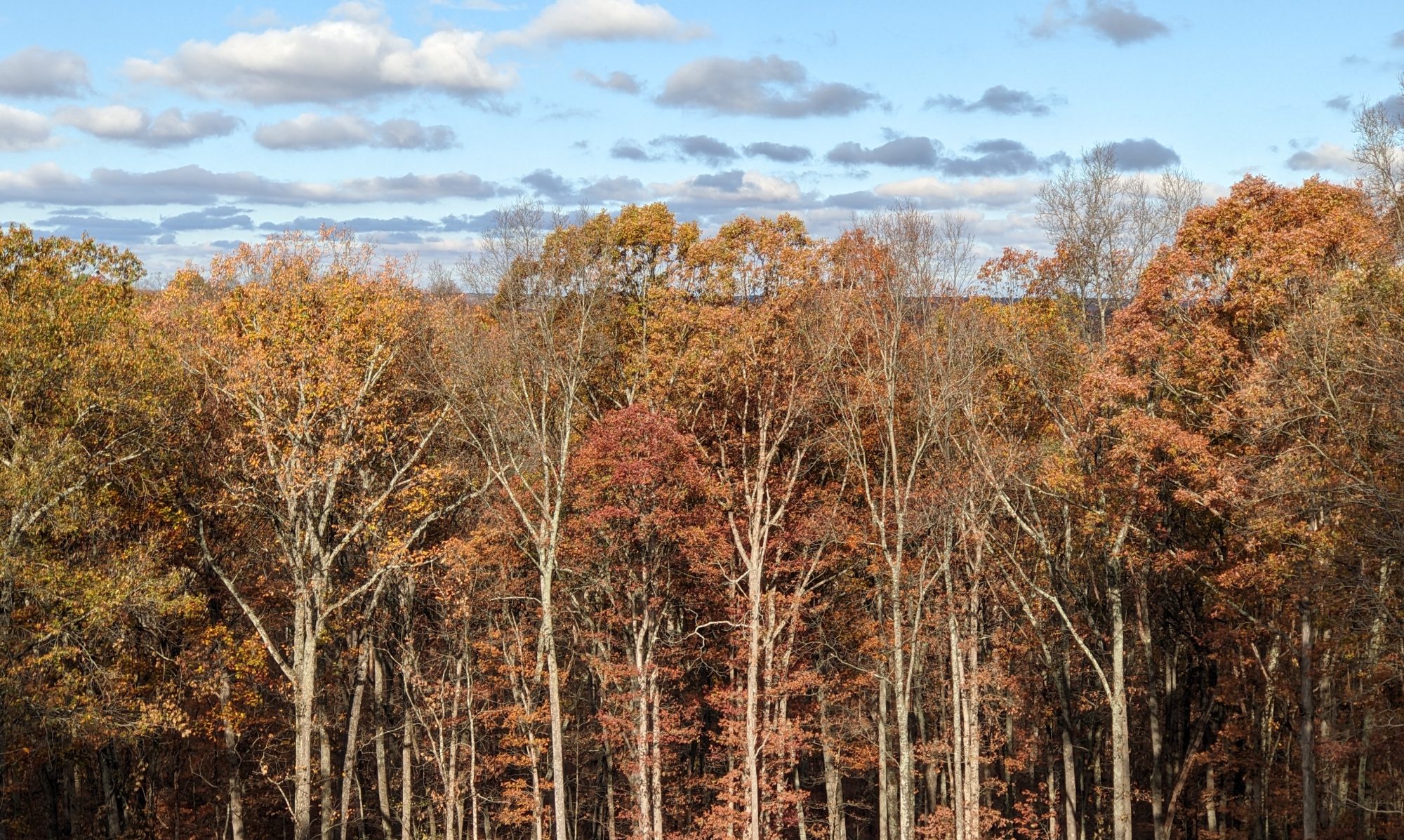
It was a beautiful Tuesday morning, so after I saw my daughters off to school, I headed for one of my favorite spots in southern Indiana.  Passing through the covered bridge at the north entrance to Brown County State Park, I entered my sanctuary from the world, my sanctum sanctorum.  I headed for Weed Patch Hill and Trail 10, or what I have always referred to as the Fire Tower Trail as it begins behind that landmark.  I put on my pack, silenced my cell phone, entered the woods and left my troubles behind for the rest of the morning.

For many years, I had let the sun chase me out of bed and into the office, but now I let it chase me into the woods.  It is here that I coax out thoughts about life and nature that I eventually shape into words.  I no longer concern myself with how to survive in the for-profit world that too often treats a person as an expendable commodity.  There were some who would brag about how many hours they worked or how many miles they traveled on their latest business trip.  They wore it like a badge of honor won on the battlefield of business.   What injury did they sustain in their effort?  How many long hours, miles of asphalt, airport bars, hotel rooms, and neon is it worth?   Perhaps one day they will finally discover their fatted calf, but then won’t have the strength to celebrate.

The drive from my door to the park entrance is 23 miles and it takes about 30 minutes.  I dare say I get more out of those miles and minutes than I ever got out of 1,000 miles and all those days chasing a dollar.  So what lies at the end of these miles and minutes?  Well, to begin with, 16,000 acres of hills, ridges, and ravines in which to “lose” myself.  There are the hardwood forests, spring wildflowers, Strahl and Ogle Lakes, streams cascading down ravines in the spring, the howl of a coyote, the hoot of an owl, the fall colors, and the solitude of a winter hike.  No, it’s not the Tetons but it wears its beauty proudly.  I have experienced each of its seasons and have found beauty in even the smallest things.  Whether hiking alone or with a kindred spirit, each experience is one of discovery.

But it is more to me than just the scenery, this place gives comfort to my spirit, it is my home ground, the place where my flesh and bones are rooted in the soil.  It is a deeply spiritual place.  When I am in these woods the trees embrace me as if I were family, the smells bring comfort like my mother’s kitchen, the sights are like a homecoming after a long journey, and the sounds are like a favorite song.  I have walked through these woods when I was full of joy and sorrow, dealing with death and life.  I have been here on a Christmas morning, a warm spring day, and on a cold winter night.  I have broken bread here with friends and family.  On this ground, I have celebrated my youth, welcomed middle age, experienced the depth and beauty of nature, and pondered over my remaining years.  It is here that I feel more in the presence of God than in any church pew.  One day, I will take my last walk on this ground and embark on that final adventure, but my spirit, chased by the sun, will linger in this place.